
Using AI and standards to transform complex B2B quoting and ordering
The Big Deal Phase II Catalyst - shows how AI supported by TMF aligned structures can generate a complete, browsable, editable and fulfillable response to a complex enterprise RFP.

Using AI and standards to transform complex B2B quoting and ordering
Using AI and standards to transform complex B2B quoting and ordering
Complex B2B telecom deals are difficult to win and even harder to deliver profitably. A single enterprise request for proposal can span multiple products, services, suppliers, sites, markets, delivery teams and approval steps. For communications service providers (CSPs), that complexity can slow responses, increase pursuit costs and make it harder to create commercially robust offers.
Building on Phase 1, The Big Deal Phase II shows how AI can work with enhanced TM Forum ODA structures and runtime catalog models to support complex enterprise solutions that are difficult to manage in traditional telecom systems. Phase 1 demonstrated the business value of this approach, including more accurate quoting, better control of revenue leakage, and improved flow-through fulfilment.
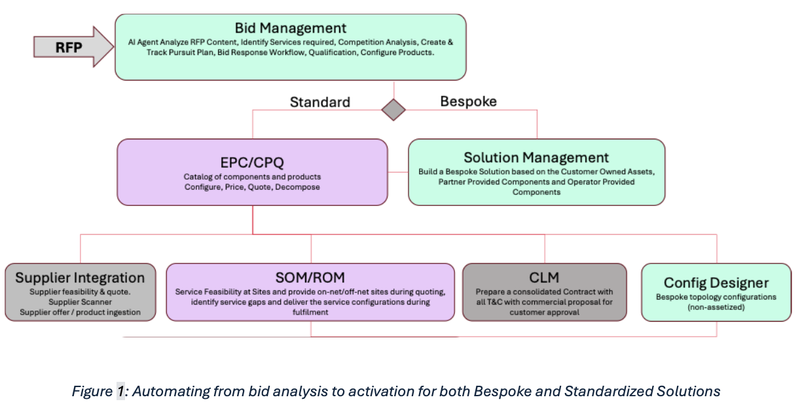
In Phase II, MCP services expose this richer product and service model to AI. We demonstrated how the AI can ingest an enterprise RFP, extract customer intent, identify locations, qualify sites, select appropriate products and access options, including on-net and partner choices, and configure a quote-ready solution. It can also help price the offer to balance win probability and margin.
Importantly, the result is a fully transparent recommendation. Because the solution is grounded in catalog-defined rules, TM Forum-aligned APIs and fulfilment logic, the proposed configuration remains browsable, editable, and fulfilment-ready. A human agent can review the AI’s choices, adjust the solution where needed, and take ownership of the final deal.
Replacing fragmented deal processes with a standards-based flow
Many enterprise sales journeys still depend on manual coordination between solution designers, commercial approvers, suppliers, specialists and local delivery teams. When those activities sit across disconnected tools and processes, quote development becomes slower, less predictable, and more exposed to errors that can affect fulfilment and profitability.
The integration challenge adds another layer of complexity. Many third-party suppliers and adjacent industry domains are not fully aligned to TM Forum APIs, making catalog ingestion, service qualification, ordering and lifecycle management expensive to integrate and difficult to scale. As a result, CSPs can struggle to commercialize new enterprise propositions quickly, even when the market opportunity is clear.
The Big Deal Phase II addresses this by creating an intelligent B2B journey that connects RFP intake, agreement, qualification, quoting, ordering, fulfilment and billing. AI accelerates work that is currently manual, while TM Forum standards provide the common structure needed to reduce friction across partners, systems and domains.
Ready to activate
The configured solutions are fulfillable. Interactions with the production layer and partners through TM Forum APIs during quoting have allowed the detailed configuration to be validated as fulfillable so that the complex set of orders can be sequenced and delivered without human touch.
Connecting agreement, qualification, ordering and fulfilment
The Catalyst uses a broad set of TM Forum assets to support the quote-to-order journey. TMF651 Agreement Management enables machine-consumable agreement terms to flow into quoting and downstream execution. TMF645 Service Qualification supports bulk qualification of complex multi-site demand, while TMF622 Product Order acts as the commercial control plane for order creation, milestone tracking and billing initiation. TMF641 Service Order supports on-net service execution and service-order progress tracking.
The project also draws on TMF673, TMF679, TMF620, TMF637 and the Information Framework (SID) across designer and partner-interaction patterns. Together, these assets support technical requirement response, supplier interaction, product-component import, custom component design, pricing, and bill-of-material management for complex enterprise solutions.
Additional assets include TMF760 for configuration management and change-oriented patterns, the Intent Common Model (TR290), TR292B Intent Management State Machines, IG1167 ODA Functional Architecture, SIDand Ready for ODA architectural guidance.
The Catalyst is also proposing practical extensions. These include SID enhancements for richer relationship modelling across complex enterprise products and services, TMF651 extensions to improve the integration boundary between CPQ and contract lifecycle management, and TMF760 enhancements for enterprise-grade localized rendering and experience support.
Making complex B2B solutions faster, cheaper and more scalable
For CSPs, the potential impact is faster time to market for new B2B products and offers, quicker quoting and approvals, and more automated fulfilment of complex services. By improving commercial control from quotesthrough fulfilment and billing, the solution also aims to protect profitability and reduce revenue leakage from poorly controlled changes.
For the wider industry, the Catalyst points to a more scalable model for complex enterprise services. Instead of relying on fragmented partnering and manual quoting, CSPs can use AI-assisted workflows, standards-based APIs and flexible catalog patterns to create a more repeatable approach to solutioning, approval and delivery.
“This Catalyst solution is valuable because it tackles one of the hardest problems in enterprise telecom: how to quickly assemble, sell and deliver complex multi-party solutions without creating excessive integration cost or operational drag,” says Amit Sharma, IT Director, Orange Business. “It shows a more scalable industry model where AI assists teams, TM Forum standards remain central, and suppliers with different technical maturity can still participate in a commercially viable ecosystem.”
Why it matters
Complex enterprise opportunities are an important growth area for CSPs, but they remain difficult to scale profitably. The Big Deal Phase II shows how AI and TM Forum standards can work together to reduce complexity, accelerate deal cycles and improve confidence from quote through fulfilment.
By helping CSPs configure, sell and deliver multi-party B2B solutions faster and more cost-effectively, the Catalyst opens the door to broader enterprise service innovation and more sustainable revenue growth.
What next
The next step is moving from Catalyst validation to commercial application. Phase II demonstrated a working model for AI-assisted enterprise bid management, catalog-driven configuration, and fulfilment-ready delivery across complex B2B scenarios.
That progress was made possible through ecosystem collaboration. CSG, Blue Planet and Infosys contributed complementary capabilities across CPQ, production-layer intelligence, AI-driven solution management and fulfilment, while Orange Business, Vodafone and IOH helped shape the requirements as active champions.
The opportunity now is to extend the model beyond the Catalyst environment: improving RFP ingestion accuracy, enabling more dynamic product and service creation, and applying the same standards-based approach to a wider set of enterprise use cases. For CSPs, that could be an important step toward making complex B2B growth faster, more repeatable, and more profitable.

