Login
Register


Member Insights
Pegasystems' Fari Pirouz looks at the structural break in AI economics and how telecoms operators can govern AI at scale.
 Fari Pirouz, Pegasystems
The future of AI depends on governing decisions, not tokens
Telecoms operators are scaling generative (GenAI) on a shared assumption that frontier models will power decisions at scale with the unit cost falling as adoption grows. That assumption could be flawed – and getting it wrong could cost the industry billions.
While traditional software costs fall per transaction at scale, GenAI costs rise. Every prompt, retrieval, reasoning loop and agentic iteration burns tokens, and better quality burns more.
As shown in the chart below, a Tier 1 communications service provider (CSP) scaling 5 million to 50 million monthly interactions sees costs rise 8 to 15 times while volume rises 10 times. This structural break isn’t temporary. (Note that the figures included in this blog are illustrative, drawn from published token pricing ranges and industry analysis to show orders of magnitude rather than any single operator’s cost base.)
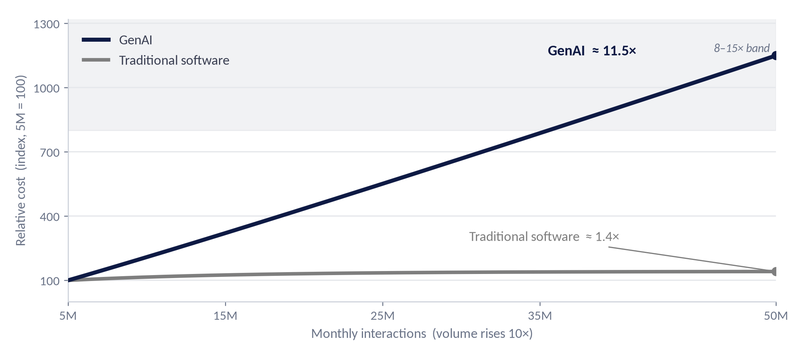
Token prices are falling fast, and that could be a trap. Unit costs are declining, but consumption is growing even faster. Agents may make 10 to 20 model calls per task; retrieval expands context windows; and always-on agents are designed to work continuously, not sit idle. As a result, the bill can keep rising even as token prices fall.
Gartner projects that power shortages could constrain 40% of AI data centers by 2027 as new grid connections and data centers take years to build. Governance, not cheaper tokens, is the only sustainable lever.
Three things make this problem acute for CSPs: volume, latency and accountability.
Volume – a Tier 1 operator handles millions of orders, incidents, queries and billing events a day, so the cost per token becomes expensive per outcome and at scale. At frontier model list prices, a typical 2,400-token interaction costs around 1.6 cents to resolve. For a telecom operator handling 10 million AI-assisted interactions a month, that equates to about $160,000 in monthly inference costs alone.
The real challenge is that this is just overhead. Roughly 40% of the token spending buys context retrieval, not business value.
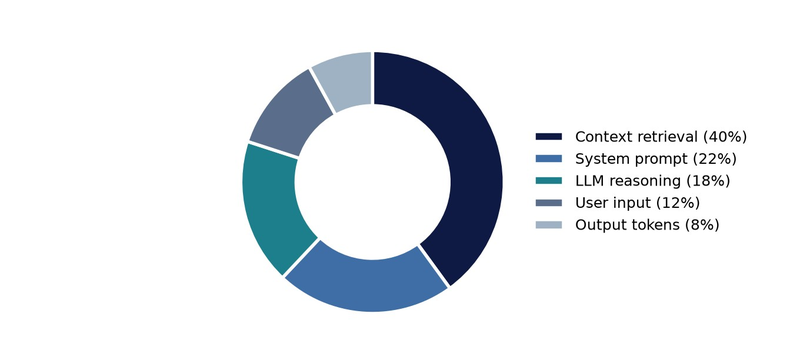
Latency – network automation, incident response or real-time billing consume tokens at decision time. Cost is incurred immediately. Therefore, governance and control should come before invocation, not in a monthly report that looks back at spending when it’s too late.
Accountability – when regulators and auditors review a CSP’s AI governance (and it will happen), they must show that alternatives were considered and that the cost is justified by the value it brings. That is a process test, not a budget question, which is impossible when large language models (LLMs) are wired into agents and connected to other agents with no runtime control.
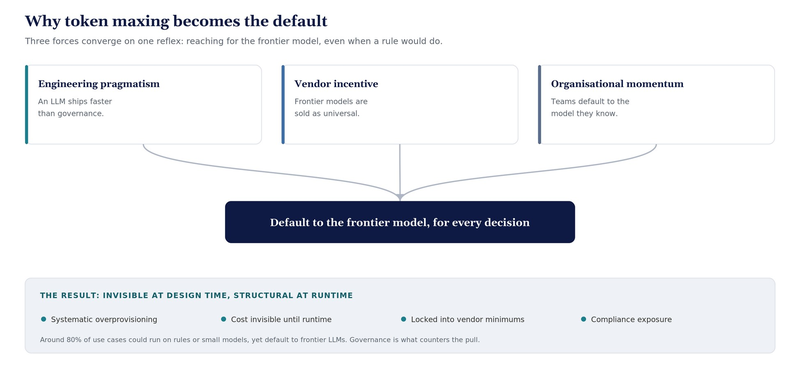
Operators shouldn’t have to choose between predictable workflow operations and fearless innovation. Yet token maxing, reaching for the most capable model even when a rule would do, forces exactly that choice.
Token maxing is becoming the default. Three forces are driving this behavior: engineering pragmatism, vendor incentives and organizational momentum.
Around 80% of use cases could run on deterministic rules or small AI models yet they default to frontier LLMs. A single agentic workflow (purely agent to agent) can cost 3 to 15 times as much as a single-shot prompt. These costs are rarely apparent during solution design but become substantial at runtime and scale.
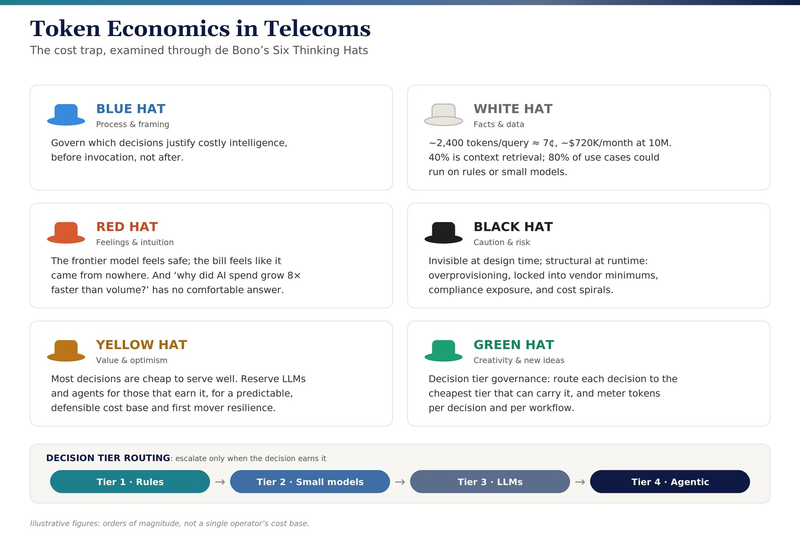
Operators can address this by classifying every decision based on complexity, risk and value and then routing it to the cheapest tier as shown in the image below.
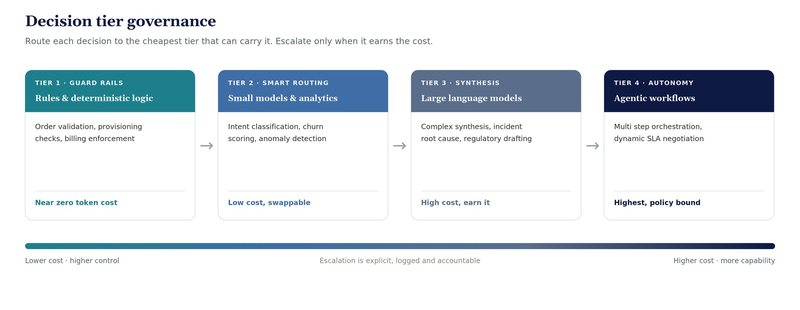
The idea is not to pay for inference when a person is waiting or if reasoning is required, but execute deterministically (and ensure consistent repeatability) wherever the work can be predefined. The unit that matters is cost per decision, not cost per token. The less expensive tiers get cheaper per decision as you scale, while the agentic tiers compound. This divergence and maximizing tokens, not the price of tokens, is the real structural break in AI economics.
Discipline should live at the decision layer, enforced centrally where business teams define which decision classes justify high-cost intelligence. Technical teams enforce routing and meter tokens against cost, latency and risk thresholds. This means governance becomes a design principle, not an afterthought.
The platform that delivers this does not replace the frontier models, but rather it harnesses and orchestrates them. Anthropic’s Claude, OpenAI’s GPT and Google Gemini sit behind a control layer that decides which model, or which rule, handles each decision, and runs it providing predictable cost.
The governed decision logic is the durable and important asset; the model is a replaceable component insulated from inference price volatility. This approach is proven with banks, operators and governments already gating fraud alerts and payment resolution this way.
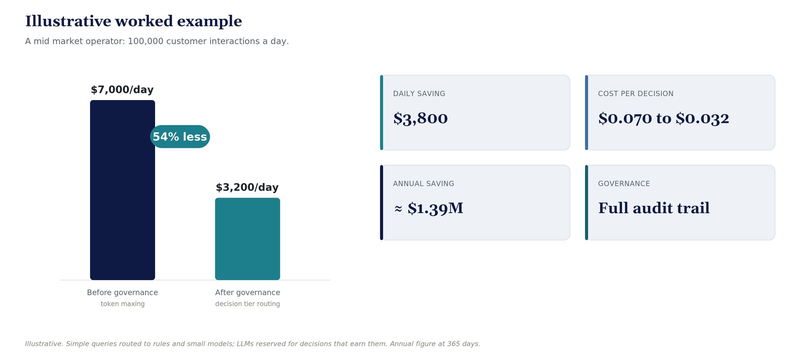
The graphic below shows an example, where a mid-market operator with 100,000 interactions a day is able to cut costs by 54%, from $7,000 to $3,200, while gaining an audit trail. Governing decisions also reduces costs by cutting the volume of downstream inference calls.
Dr. Edward de Bono, a well-known physician, psychologist and author, introduced the Six Thinking Hats in his 1985 book of the same name. The method encourages participants to adopt six distinct perspectives, each represented by a different metaphorical hat and way of thinking. As shown in the graphic below, whichever lens CSPs take – engineer, CFO, regulator or strategist – the conclusion is the same: Govern before scale.
In June 2025, Gartner predicted that more than 40% of agentic AI projects will be cancelled by the end of 2027 because of escalating costs, unclear business value or inadequate risk controls. Without governance, CSPs cannot answer basic questions such as why spending is outrunning usage or what the cost per decision is. Then, budgeting, procurement and FinOps reporting all arrive too late.
First-mover advantage is measurable. As shown in the example below, an operator handling 50 million interactions a month could reduce its annual GenAI run-rate costs from roughly $43 million to $19 million through decision-tier governance for a savings of about $24 million a year.
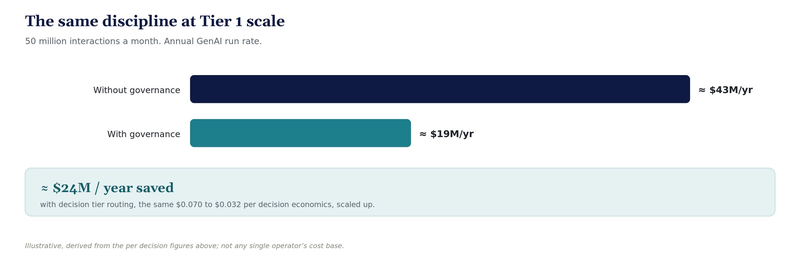
While competitors continue to token max, relying on expensive frontier models and agentic workflows by default, operators implementing governance can scale AI faster, at lower cost and with greater control. That delta makes the case for return on investment and proves that agentic costs are governable, not bill shock waiting to happen.