Lumen outlines AI connectivity strategy
 Ed Finegold
Lumen outlines AI connectivity strategy
Lumen Technologies is betting large on a transformation from a legacy telco into an AI-centric connectivity provider. At a time when telcos worldwide are assessing how AI will shape their future infrastructure, we caught up with Lori Garcia, SVP Strategy, Experience and Commercial Excellence for Lumen, to discuss how the company’s plans to build a telco for the AI era are unfolding.
Lumen’s stated strategy is to be “the trusted network for AI,” according to Garcia. The telco began its massive strategic makeover in 2020, rebranding from CenturyLink to Lumen to shed its legacy image.
During the past five years the company has also sold most of its legacy copper network and other non-core physical assets; created a technology partner ecosystem with AWS, Corning, Cisco, Ciena, Digital Realty, Fortinet, and Palantir; expanded its fiber network footprint; and delivered a secure, NaaS-based, on-demand connectivity fabric designed specifically for enterprise AI workloads.
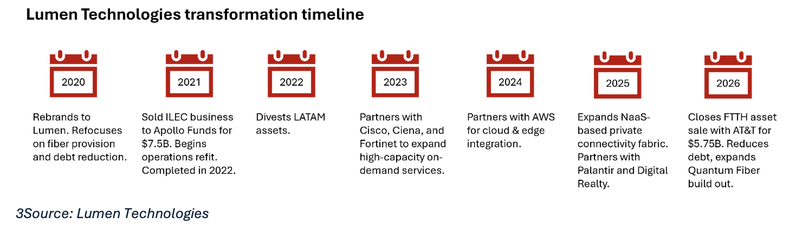
Behind the scenes, Lumen has worked hard to address common telco problems ranging from disjointed networks and duplicative legacy systems to inaccurate operational data. The company has focused on automating its network operations, developing its strategic partner ecosystem with key suppliers for leading edge technologies (see chart), and targeting markets to transport AI training and multicloud workloads for enterprises.
Lumen also reimagined its product suite for AI applications, including:
- Internet on Demand (IOD) to offer reliable connectivity provisioned in minutes
- Managed SASE for zero trust security across distributed AI workloads
- DDoS Mitigation to protect high-value traffic
- 400G Wavelength Services and Dark Fiber for high-capacity connections
- Programmable Connectivity, enabling dynamic path control for multi-cloud and edge integration
- IP VPN and Colocation, providing secure interconnections between data centers and workloads
These services in turn support various stages of the AI data lifecycle:
- Data ingestion: Direct Internet and 400G Wavelengths for analytics data import
- Training: Dark Fiber and Colocation for AI/ML clusters
- Inference/serving: Programmable Connectivity and SASE for real-time and edge AI
- Multi-cloud access: IP VPN and Programmable Connectivity for AI-based personalization
On-demand fabric replaces over-provisioning
Traditionally, telcos have forced customers to pre-purchase and pre-plan their connectivity in a static, over-provisioned fashion while paying for their peak needs. In today’s market, however, “customers want more flexibility and more flexible models,” Garcia said. To meet this type of demand, Lumen “is shifting to operate as a cloud-like network provider,” explains Garcia, to provide capacity on-demand but also with a high degree of resiliency.
“This is Cloud 2.0,” said Garcia. “AI is super resource intensive with an interplay of CPU, GPU, and storage along with power and cooling, so that’s the way we are thinking about serving customers,” Garcia explains. What’s needed, she says, is bandwidth on demand but also interconnectivity fabric. “Investments in network infrastructure are expected to mirror those in power and cooling, and Lumen is ready to meet that demand.” Garcia said.
Increasing need for edge and local AI support
Garcia says Lumen sees AI architectures hybridizing. "Customers are evolving away from a cloud-only mentality to do more computing anywhere they want; on premises, on the cloud and at the edge so they can more AI applications where they need to," she says.
“Edge as a service is super critical because customers are deploying hybrid architectures to keep things closer, but also to be able to burst out to the cloud,” Garcia explains. She adds that Lumen is “designing for these burstable moments” where enterprises “need more capacity to show up and a network that is built for maximum flexibility.”
For example, Garcia explains that retailers have been installing cameras not only in stores but on every shelf for a variety of purposes from inventory management to loss prevention. These video workloads are then processed locally or at the edge with AI solutions suited to specific tasks and goals, but they also need on-demand connectivity to burst workloads to clouds for training and additional inference purposes.
This model supports use cases ranging from this retail video use cases to “manufacturing and more autonomous systems and robotics at the edge” where Lumen wants to “bring the network to them,” according to Garcia.
“AI has given us the opportunity to rethink everything we do and how we do it. And we are excited to help our customers accelerate their AI journeys to create new value with best-in-class network, security, and communications services,” Garcia says.
The world awaits a clear tally
There are indications that Lumen’s strategy could pay off. It reported a 29% growth in its NaaS customer base – a key success metric given Lumen’s NaaS-centric message.
Meanwhile the company is continuing to shed debt by divesting local and foreign network assets no longer relevant to its business. For example, its sale to AT&T of nearly $6 billion in local fiber network assets closed in Q1 2026.
It is also raising cash. Indeed, among its investors is Lumen Technologies CEO, Kate Johnson, who invested another nearly $500,000 in Lumen by purchasing 78,685 shares at an average price of $6.35. News of Johnson’s purchase quickly elevated Lumen share price at the time by nearly 30%.
Overall, however, Lumen’s investments have yet to translate into positive financial results. And the fact that Lumen is mid-transformation means its financial picture remains cloudy. As it sells non-core assets and lines of business, and re-invests in its network and operations capabilities, its revenues fluctuate, losses persist, and growth is occluded by the noise. At the same time, the company is reducing its debt and debt-related expenses while raising cash and reducing operations costs.
Lumen recognizes it has plenty of work yet to do to emerge as a profitable company that grows consistently quarter over quarter and year over year. With its CEO re-investing in the business, it may signal Lumen’s leadership is confident that the risks it took during the past half decade, combined with the demand it now sees for transporting enterprise AI workloads, will soon deliver the positive financial results they anticipated.