Login
Register

 Joanne Taaffe, TM Forum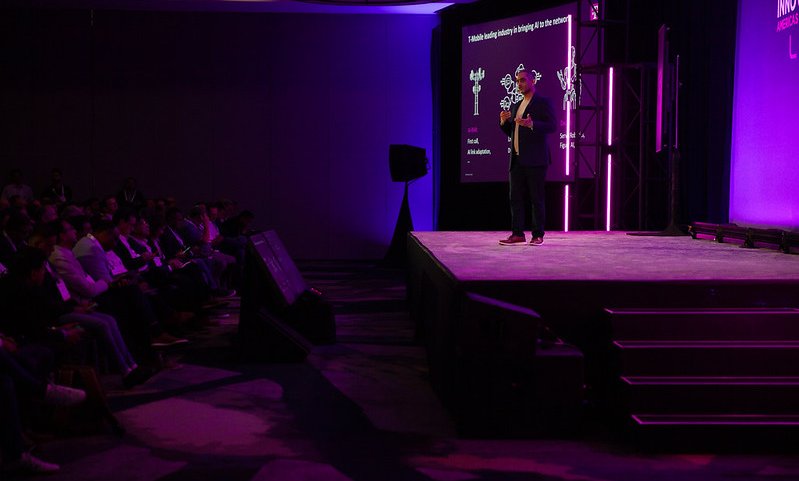
How AT&T and T-Mobile are architecting networks to gain an AI advantage
Does AI present telcos with unique competitive advantages? Ankur Kapoor, Executive Vice President, Networks of T-Mobile, speaking at TM Forum’s Innovate Americas, believes so.
“There is no better time to be in the telco industry. Because telecom networks are uniquely positioned to lead in this era,” claimed Kapoor, stating that: “The next journey is from autonomous networks to autonomous worlds.”
However, communication service providers’ (CSPs) ability to lead may depend on progress in building end-to-end network intelligence.
“The networks have to reason [and] change and that intelligence will have to reside in every part of the network not just in centralized areas.”
Get it right, and it means that networks are “not a dumb pipe. Networks are going to become the nervous system of this connectivity layer,” said Kapoor.
Autonomous worlds, however, are a tall order and will demand a level of network autonomy that won’t be achieved in the immediate term.
“Level 4 [of network autonomy] would be amazing, but it's not going to be enough,” said Kapoor. “Autonomous worlds is going to require for us to get to level five.” What differentiates four and five, explained Kapoor, is the interaction between different systems. Whereas operators can develop level four automation in pockets of the radio or core network and introduce some cross-domain automation “level five would require all these systems to interact with each other. All that intelligence to work seamlessly between a device and the network,” said Kapoor. “And it I can't stand here and say we can do it alone.”
Instead, he calls for “that radical collaboration... that's required through every single part of this: network, devices, data, OEMs, chipsets, device manufacturers. Everybody will have to come together." Particularly as the industry advances towards 6G, a development that Kapoor wants the US to lead: "That's the race to 2030. We have to shape 6G with the real workloads."
In the meantime, T-Mobile is working toward greater network autonomy, helped by its investments in 5G Advanced to provide cloud-native, programmable and open systems, and the deployment of a 5G SA network.
When it comes to services, Kapoor identified physical AI as a key opportunity and "the proof point of autonomous worlds."
AT&T also has its eye on physical AI, as Igal Elbaz, the company's Senior Vice President, Technology and Network Services, Network Chief Technology Officer, explained in his keynote address at Innovate Americas.
AT&T’s investment in AI agents, for example, are not only an engine for autonomous networks, explained Elbaz. “It's also an engine for physical AI: new devices [such as] robotaxis, drones, food delivery, robots, humanoids. Those physical AI will need access to inference and models, and that can be in the cloud or that can be in distributed edges.”
Like T-Mobile, AT&T has been making investments in network intelligence and autonomous network operations. The company now aims to reach level four of autonomy in its network by 2030, said Elbaz, and can already claim to have achieved level 4 in the RAN.
However, “for true autonomy, you need intent and closed loop” pointed our Elbaz, and he emphasized the importance of unifying network autonomy across domains. “It's crossing different network domains. And not all of them are at the same pace of modernization. So we have to get into the same place across all of it.”
Conflict resolution is one example of why this is necessary, according to Elbaz. “When you run different agents and apps or R-apps across your wireless network, they might conclude different actions. How do you manage those conflicts in real time?”
Elbaz emphasized the role of AT&T’s Open RAN strategy in building and designing a network for openness, programmability, and intent. AT&T now expects to have 70% of its traffic flowing through open interfaces by the end of this year, according to Elbaz. And it is rolling out SMO [service management and orchestration] based on open interfaces.
“All of our cell sites are going to integrate into that SMO. We believe we're going to be done with this by the end of next year.” The result will be “open data model and interfaces to all of our RAN and being able to use near real-time, closed-loop, and programmability into our RAN platform."
Yet, despite this progress, Elbaz emphasized the importance of taking the time to get automation right.
“Why not faster? We are operating mission-critical infrastructure. We have a very narrow margin of error. So, we have to be smart about what are we doing,” he explained. “What is important is that we have a framework to benchmark against, but also … focus on the outcomes."